
If you are evaluating equipment for drinking straw production, you have likely encountered the term “PP drinking straw extruder” more than once. But what exactly happens inside this machine? How does polypropylene—a material better known for automotive parts and food containers—become the flexible, lightweight straws used in millions of beverages every day?
Understanding the extrusion process is essential before making any equipment decision. This article breaks down how a PP straw extruder works, explains the key components that determine product quality, and highlights the factors that separate reliable production from constant downtime and rejected products.
Why Polypropylene (PP) for Drinking Straws?
Polypropylene is one of the most widely used thermoplastics in the world, and for good reason. When it comes to drinking straws, PP offers a combination of properties that few other materials can match:
| Property | Why It Matters for Straw Production |
|---|---|
| Chemical resistance | PP resists acids and bases, meaning straws won’t degrade when in contact with beverages |
| Durability | The material is tough and flexible, allowing straws to bend without breaking |
| Lightweight | Reduces shipping costs and makes straws easy to handle during production |
| Heat resistance | PP can withstand the temperatures required for extrusion without degrading |
| Recyclability | PP straws are recyclable, offering manufacturers a path to lower environmental impact |
What this means for you: The material you choose directly affects your production parameters. PP has a relatively wide processing temperature window compared to biodegradable alternatives like PLA or PBS, which makes it more forgiving for operators and reduces the risk of material degradation during production. This is one reason why PP remains a popular choice for high-volume straw manufacturing—despite regulatory shifts, plastic straws still held a significant share of 45%–50% of the disposable straw market in 2025.
The PP Straw Extrusion Process—Step by Step
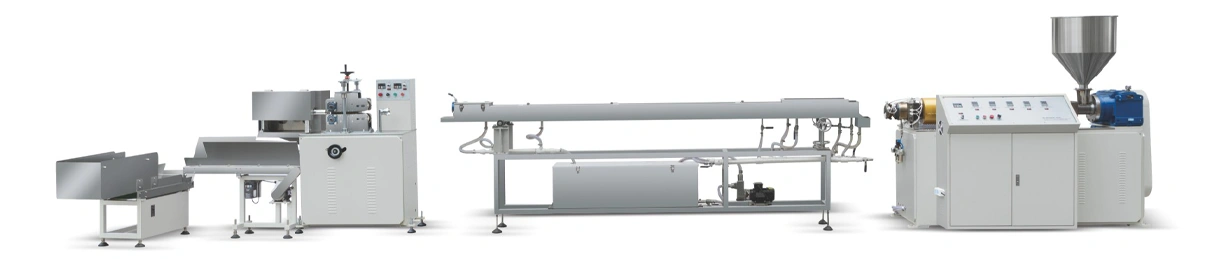
A PP straw extruder transforms raw polypropylene pellets into continuous hollow tubes through a process called extrusion. Here is how it works, stage by stage:
Step 1: Feeding
Raw PP pellets are loaded into the hopper—a large funnel-shaped container at the rear of the extruder. From there, the pellets are fed into the barrel through a feed throat. At this stage, colorants or other additives may be blended with the base material to produce straws in different colors or with enhanced properties.
Step 2: Melting and Plasticizing
Inside the barrel, a rotating screw conveys the pellets forward. The barrel is heated by electrical heating elements, but much of the melting actually comes from shear heating—the friction generated as the screw rotates and the material is compressed against the barrel wall. The screw itself is divided into three zones:
-
Feed zone: Deep channels that simply move the pellets forward
-
Compression zone: Shallower channels that compress the material against the heated barrel, initiating melting
-
Metering zone: Delivers a uniform melt at a steady pressure to the die
Why this matters: If the temperature is too high, the PP can degrade, resulting in weak or discolored straws. If it is too low, the material won’t melt completely, leading to inconsistent wall thickness and poor product quality. Temperature control precision is therefore one of the most critical factors in equipment selection.
Step 3: Shaping Through the Die
The molten PP is forced through a die—a precision-machined component that determines the straw’s diameter and wall thickness. For straw production, the die includes a central mandrel that creates the hollow center and an outer ring that defines the outside diameter. An air inlet introduces a stream of air into the tube as it exits, keeping it open.
Why this matters: The die is the single most important component for product quality. Even minor imperfections can result in oval cross-sections, inconsistent wall thickness, or surface defects. This is why manufacturers with experience in precision engineering—such as those employing coordinate measuring machines (CMMs) for 100% random inspection of core components—tend to produce more consistent results.
Step 4: Cooling and Solidification
The newly formed plastic tube is still soft and must be cooled rapidly to maintain its shape. This is typically done by passing the tube through a cooling water tank. The cooling process must be uniform; uneven cooling can lead to warping, oval shapes, or internal stresses that weaken the straw.
Why this matters: Inadequate cooling is one of the most common sources of quality issues in straw production. A well-designed cooling system with consistent water temperature and flow is essential for producing straight, round straws with uniform wall thickness.
Step 5: Pulling and Cutting
Once cooled, the continuous tube is pulled forward by a take-off unit that maintains constant tension. The speed of this pulling unit works in coordination with the extruder speed to control wall thickness—faster pulling results in thinner walls.
Finally, a cutting unit slices the continuous tube into individual straws at the desired length. Precision cutting ensures clean, burr-free edges and consistent lengths.
Step 6: Packaging (Downstream)
After cutting, finished straws are typically fed into packaging equipment—either single-straw wrapping machines or multi-straw bagging machines—to prepare them for distribution.
For manufacturers looking to understand how extrusion integrates with downstream operations like bending and packaging, exploring complete straw production solutions can provide a clearer picture of the full workflow.
Key Performance Factors in PP Straw Extrusion
When evaluating a PP straw extruder, the following factors directly impact your production quality and efficiency:
| Factor | What It Controls | Real-World Impact |
|---|---|---|
| Temperature control accuracy | Melt consistency | Prevents material degradation and ensures uniform wall thickness |
| Screw design | Melting efficiency and output rate | Different screw geometries work better for different materials |
| Die precision | Diameter and wall thickness | Determines whether straws meet dimensional specifications |
| Pull speed control | Wall thickness | Allows adjustment between different straw gauges |
| Cooling system design | Dimensional stability | Prevents warping and oval cross-sections |
| Cutting accuracy | Length consistency | Ensures every straw meets length specifications |
What this means for you: A machine with superior temperature control and precision components will produce higher-quality straws with less waste. For example, full servo control systems can maintain diameter and length tolerances within ±0.1mm, ensuring consistent product quality across millions of straws. This translates directly into lower scrap rates, fewer customer complaints, and higher profitability.
For manufacturers producing drinking straws from various resins — including PP, biodegradable PLA and PBS — the capacity to switch raw materials without complex mechanical retooling is a vital evaluation indicator. Our flexible-design PP drinking straw extruders support quick material switching, drastically cutting production changeover downtime and allowing you to expand your disposable and biodegradable straw product portfolio.

PP vs PLA vs PBS—How Material Choice Affects Your Extruder
While this article focuses on PP straw extrusion, it is worth understanding how PP compares to other common straw materials—especially given the growing regulatory pressure on single-use plastics.
| Consideration | PP (Polypropylene) | PLA (Polylactic Acid) | PBS (Polybutylene Succinate) |
|---|---|---|---|
| Material source | Petroleum-based | Plant-based (corn, sugarcane) | Plant-based or petroleum |
| Biodegradability | Recyclable, not biodegradable | Compostable (industrial) | Biodegradable |
| Processing temperature | Wide window, forgiving | Narrow window, requires precision | Moderate window |
| Equipment requirements | Standard extruder | Modified screw and cooling | Specialized screw design |
| Market demand | Declining in some regions | Growing | Growing |
What this means for you: If you plan to produce multiple material types, your equipment choice matters even more. PP is the most forgiving material to process, making it ideal for operators who are new to extrusion. PLA requires tighter temperature control and specific screw designs to avoid degradation. PBS—a material where ANBO has particular expertise as China’s first certified PBS straw machine manufacturer—requires its own specialized approach.
Understanding these differences is the first step in choosing the right equipment for your production goals. You can explore material-specific production lines to see how each material is handled from extrusion to packaging.
From Understanding to Equipment Selection
Now that you understand how a PP straw extruder works—from feeding and melting to shaping, cooling, and cutting—you are better equipped to evaluate the equipment that will actually go into your production line.
The key takeaway is this: the extruder is the heart of your straw production line. Its design, precision, and control systems directly determine the quality, consistency, and efficiency of your output. When comparing options, focus on:
-
Temperature control precision—how tight are the tolerances?
-
Screw design—is it optimized for PP and any other materials you plan to run?
-
Die quality—what precision standards are used in manufacturing?
-
Cooling system—does it provide consistent, adjustable cooling?
-
Cutting accuracy—what length tolerances can the machine maintain?
-
Changeover time—how quickly can you switch between different straw diameters or materials?
Once you finalize these key selection criteria, comparing detailed technical specifications of different units is the sensible next step. Browse ANBO’s complete drinking straw production line to learn how diverse machine layouts match different output volumes and manufacturing demands.
Related Reading
-
PLA vs PP Straw Production: Key Material Differences and Processing Considerations
-
How to Choose the Right Straw Extruder for Your Production Volume
-
Understanding Straw Die Design: How Geometry Affects Product Quality
-
Cooling Systems in Straw Extrusion: Why Temperature Control Matters
-
From Extrusion to Packaging: Building a Complete Straw Production Line