
If you have ever watched a drinking straw being produced, you might have wondered: how does a machine turn a pile of plastic pellets into a perfectly round, hollow tube in just seconds? The answer lies in a manufacturing process called extrusion—specifically, the operation of a plastic straw extruder.
This article walks you through the entire straw extrusion process, step by step. Whether you are evaluating equipment for a new production line or simply trying to understand the technical principles behind straw making, this guide will give you a clear, non-technical breakdown of what happens inside the machine and why each stage matters for product quality.
What Is Plastic Extrusion—and Why Does It Work for Straws?
Plastic extrusion is a continuous manufacturing process used to produce uniform plastic products by melting raw thermoplastic material and forcing it through a specially designed die to form a fixed cross-section. The machine that performs this process is called an extruder.
For drinking straws, the extrusion process is ideal because it produces a continuous tube with a constant cross-section—exactly what a straw requires. The process is continuous, meaning it can run 24 hours a day, making it highly efficient for large-scale production.
A standard straw extruder is a single-screw extruder. Thermoplastic material—typically polypropylene (PP), polyethylene (PE), or biodegradable materials like PLA and PBS—is fed into the machine as small pellets or granules. Inside the extruder, the material is melted, mixed, and pushed through a die that shapes it into a hollow tube. From there, the continuous tube is cooled, pulled, and cut into individual straws.
Why this matters for your production: The extrusion process determines not only the speed of your output but also the dimensional accuracy, wall thickness consistency, and material integrity of every straw produced.
Step-by-Step: How a Plastic Straw Extruder Works
The straw extrusion process can be broken down into six distinct stages. Each stage plays a critical role in ensuring the final product meets quality standards.
Step 1: Material Feeding
The journey begins at the hopper—a large funnel-shaped container mounted at the rear of the extruder. Raw plastic pellets (or granules) are poured into the hopper and fed down into the extruder barrel through a feed throat.
At this stage, additives such as colorants, stabilizers, or other performance-enhancing agents may be blended with the raw material. This is how manufacturers produce straws in different colors or with specific material properties (e.g., UV resistance or enhanced flexibility).
What this means for you: Consistent feeding is essential for stable output. If the feed rate fluctuates, the resulting straws may have inconsistent wall thickness or diameter—issues that can lead to rejected products downstream.
Step 2: Melting and Plasticizing
Once the pellets enter the barrel, they encounter a rotating screw that conveys them forward. But the screw does more than just push material along—it also plays a direct role in melting it.
The screw inside a straw extruder is conventionally divided into three regions along its length:
-
Feed zone: Has a deep channel and simply drags the cold pellets away from the hopper into the barrel.
-
Compression (melting) zone: The channel gets shallower, pressing the pellets against the hot barrel wall. A thin film of melt forms between the solid bed and the wall, and the screw flight scrapes this melt off.
-
Metering zone: Shallow again, this section delivers the now-uniform melt at a steady rate and pressure into the die.
The material is melted by two sources of heat:
-
External heating: Electrical heating elements wrapped around the barrel raise the temperature to the desired melt level (typically around 200°C/400°F for many thermoplastics).
-
Shear heating (internal friction): As the screw rotates, the plastic is subjected to shearing between the rotating screw and the stationary barrel. In modern machines, most of the energy that melts the polymer comes from the screw itself, not from the barrel heaters. The barrel heaters mainly stabilize wall temperature and help with start-up.
What this means for you: The combination of external heat and shear heating must be precisely controlled. Too much heat can degrade the material; too little results in incomplete melting. This is why temperature control precision is a critical factor in equipment selection.
Step 3: Pressurization and Mixing
As the screw continues to rotate, it builds pressure and ensures uniform mixing of the molten material. This stage is crucial for achieving a homogeneous melt—one where the temperature, color, and material properties are consistent throughout.
Inconsistent mixing can lead to:
-
Color variations in the final straws
-
Weak spots in the tube wall
-
Variations in diameter and thickness
What this means for you: A well-designed screw geometry ensures that the melt is fully homogenized before it reaches the die, reducing the risk of defects and material waste.
Step 4: Shaping Through the Die
The molten plastic is now forced through a die located at the end of the barrel. The die is a precision-engineered component that determines the product's cross-sectional shape—in this case, a hollow tube with a specific diameter and wall thickness.
For straw production, the die typically includes:
-
A central mandrel that creates the hollow center of the straw
-
An outer ring that defines the outside diameter
-
An air inlet that introduces a stream of air into the continuous tube to keep it open as it exits the die
What this means for you: The die is arguably the most critical component for product quality. Even slight imperfections in the die can result in straws with oval cross-sections, inconsistent wall thickness, or surface defects.
Step 5: Cooling and Solidification
When the molten plastic tube exits the die, it is still soft and must be cooled rapidly to maintain its shape. This is typically done by passing the continuous tube through a cooling water tank.
The cooling tank serves several purposes:
-
Rapid cooling to prevent deformation and maintain dimensional accuracy
-
Guiding the tube to ensure straightness
-
Uniform cooling to avoid internal stresses that could cause warping
In some setups, a vacuum calibration device is used to ensure dimensional accuracy. The still-soft plastic tube passes through the center of the calibration device, and a vacuum draws it against the calibration surfaces to maintain precise dimensions.
What this means for you: Proper cooling is essential for producing straws with consistent diameter and roundness. Inadequate or uneven cooling can lead to oval-shaped straws or variations in wall thickness—both of which are common quality issues in straw production.
Step 6: Pulling and Cutting
Once cooled and solidified, the continuous plastic tube is pulled forward by a take-off unit (also called a pulling or haul-off device). This unit:
-
Pulls the tube at a constant speed to maintain consistent tension
-
Works in coordination with the extruder speed to control wall thickness
-
Feeds the tube into the cutting mechanism
The cutting unit then slices the continuous tube into individual straws of uniform length. Precision cutting mechanisms ensure clean edges and consistent lengths.
After cutting, the finished straws are collected for packaging or further processing (such as bending or printing).
What Happens After Extrusion? Downstream Processing
The extrusion process itself produces straight, rigid straws. However, many drinking straws undergo additional processing steps after extrusion:
-
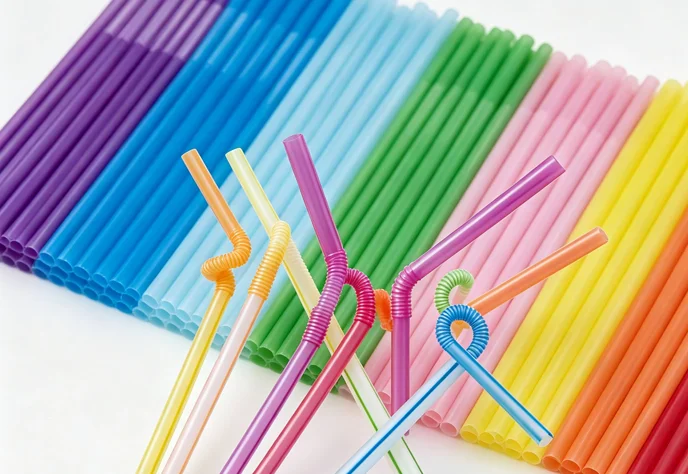
Bending: Flexible or U-shaped straws (often used in children's juice boxes) are produced using straw bending machines that heat and form the straight tubes into curved shapes.
-
Printing: Logos or decorative patterns can be printed onto the straws.
-
Packaging: Finished straws are fed into automatic straw packaging machines for individual wrapping or bulk packaging.
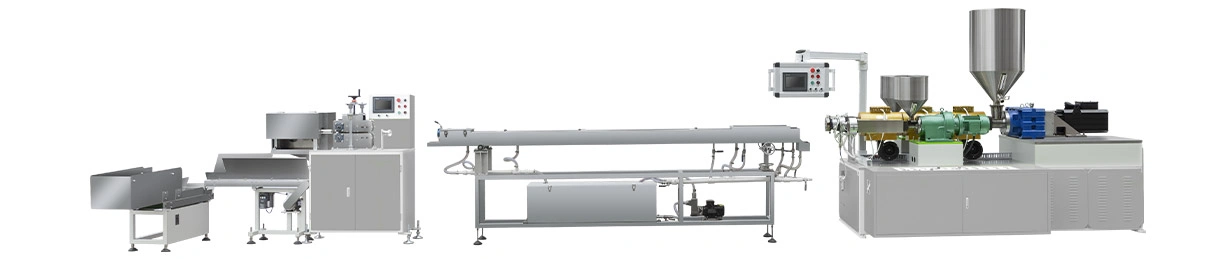
The complete straw production line typically includes all of these components: extruder, cooling tank, pulling/cutting unit, and packaging equipment. For manufacturers producing multiple straw types, modular systems that allow quick changeovers between different diameters and lengths are particularly valuable. You can explore complete straw production solutions that integrate extrusion with downstream processing for seamless operations.
Key Factors That Affect Straw Quality
Understanding the extrusion process is one thing—but what actually determines whether your straws come out consistent, strong, and visually appealing? Here are the critical factors:
| Factor | Why It Matters | What to Look For |
|---|---|---|
| Temperature control | Inconsistent temperatures cause variations in melt viscosity, leading to dimensional inconsistencies | Precision heating systems with tight accuracy |
| Screw design | Different materials (PP vs. PLA vs. PBS) require different screw geometries for optimal melting | Screws designed for specific material types |
| Die precision | Determines diameter accuracy and wall thickness uniformity | High-precision dies with smooth internal surfaces |
| Cooling rate | Affects crystallinity, clarity, and dimensional stability | Adjustable cooling systems with consistent water temperature |
| Pull speed | Controls wall thickness—faster pulling = thinner walls | Servo-driven pullers with precise speed control |
| Material quality | Impurities or inconsistent pellet size affect melt quality | Consistent raw material sourcing |
What this means for you: When evaluating straw extrusion equipment, these factors should be your primary considerations—not just output speed or price. A machine with superior temperature control and screw design will produce higher-quality straws with less waste, ultimately saving you money over the long term.
For manufacturers processing biodegradable materials like PLA and PBS, these factors become even more critical. PLA, for example, has a narrower processing temperature window than PP and requires more precise control to avoid degradation. ANBO, as China's first certified PBS straw machine manufacturer, has developed specific screw designs and temperature control systems optimized for these materials. To understand the full range of straw extruder configurations available for different materials and output requirements, you can review the detailed specifications of various models.
From Understanding to Selection
Now that you understand how a plastic straw extruder works—from feeding and melting to shaping, cooling, and cutting—you are better equipped to evaluate the equipment that will actually go into your production line.
The key takeaway? The extruder is the heart of the straw production line. Its design, precision, and control systems directly determine the quality, consistency, and efficiency of your output. When comparing options, focus on:
-
Material compatibility—can the machine handle the specific polymers you plan to use (PP, PE, PLA, PBS)?
-
Temperature control precision—how tight are the tolerances?
-
Screw design—is it optimized for your target materials?
-
Cooling system—does it provide consistent, adjustable cooling?
-
Ease of changeover—how quickly can you switch between different straw diameters?
Related Reading
-
PLA vs. PP Straw Production: Key Material Differences and Processing Considerations
-
How to Choose the Right Straw Extruder for Your Production Volume
-
Understanding Straw Die Design: How Die Geometry Affects Product Quality
-
Cooling Systems in Straw Extrusion: Why Temperature Control Matters
-
From Extrusion to Packaging: Building a Complete Straw Production Line