
The drinking straw market is undergoing a fundamental transformation. According to industry data, the global paper straw market alone was valued at USD 1.66 billion in 2025 and is projected to reach USD 3.19 billion by 2034. Meanwhile, PLA-based straws are gaining rapid adoption due to their biodegradability and compliance with global sustainability regulations. The European Union's Single-Use Plastics Directive, which took effect in July 2021, has banned plastic straws across member states, with additional product design requirements for beverage containers coming into force in July 2024.
For manufacturers, this regulatory and market shift presents a critical question: How do you select a straw extruder that can handle multiple materials—PP, PLA, PBS—and produce both single and multi-color straws efficiently?
This guide examines the key decision factors for evaluating multi-material straw extrusion equipment. Rather than recommending specific models, we provide a framework to help you assess which machine characteristics align with your material strategy, production volume, and product differentiation goals.
Understanding Material Properties and Their Impact on Extrusion
The first step in equipment selection is understanding that different polymers behave differently under extrusion conditions. A machine optimized for PP may not perform well with PLA or PBS without specific design considerations.
Polypropylene (PP): A conventional thermoplastic with good melt strength and wide processing windows. PP extruders typically operate with a length-to-diameter (L/D) ratio of 28:1 to 33:1. PP is relatively forgiving in extrusion—it flows consistently and requires less precise temperature control than biodegradable alternatives.
Polylactic Acid (PLA): A biobased and compostable polymer derived from renewable resources. However, PLA presents distinct challenges: inherent brittleness, low melt strength, slow crystallization kinetics, and sensitivity to thermal history. Processing time and temperature can significantly affect PLA's rheological properties. For PLA extrusion, precise temperature control along the barrel and die is essential to prevent degradation while maintaining melt uniformity.
Polybutylene Succinate (PBS): A biodegradable polyester with better flexibility than PLA. Blending PLA and PBS can provide balanced performance, offsetting PLA's brittleness. Research published in Polymers (2025) found that with 15 wt.% PBS loading, the elongation at break of PLA improved from 4.6% to 193%. However, PBS also requires careful processing—small molecules in PBS material can precipitate, and food safety migration requirements are stringent.
What this means for your operation: If you plan to process multiple materials, your extruder must offer:
-
Wide temperature range capability with zone-specific control
-
Screw design optimized for both crystalline (PP) and amorphous (PLA) polymers
-
Barrel materials resistant to the corrosive byproducts that can occur during PLA/PBS processing
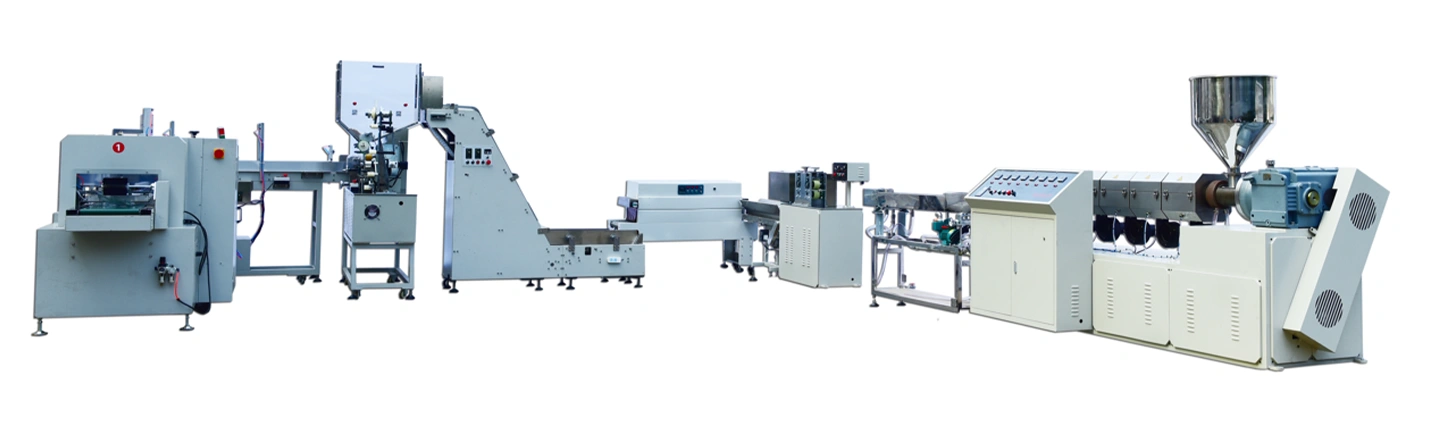
For a comprehensive overview of how extrusion integrates with downstream operations, explore complete production line solutions for straw manufacturing.
Equipment Configuration Options—Single Screw, Twin Screw, and Co-Extrusion
The choice of extruder configuration directly impacts material flexibility, output quality, and production efficiency.
Single-Screw Extrusion (SSE): The most common configuration for straw production. PLA/PBS blends can be processed either via single-screw extrusion or twin-screw extrusion compounding followed by SSE. A 2025 study found that while both routes produce blends with comparable overall performance, the PLA molecular weight drop was more pronounced in twin-screw compounding (~18.7%) compared to single-screw extrusion (~1.5%). The research suggests that the single-step SSE process can be used as a cost-effective and energy-saving approach for PLA/PBS blending without the need for pre-compounding.
Twin-Screw Compounding + Single-Screw Extrusion: This two-step approach first compounds PLA/PBS blends in a twin-screw extruder, then feeds the compounded pellets into a single-screw extruder for strand formation. While this route can achieve slightly finer PBS domain dispersion, it requires additional equipment and energy.
Co-Extrusion for Multi-Color Straws: For manufacturers seeking product differentiation through color, multi-color co-extrusion is the key technology. Extended, striped drinking straws are formed by co-extruding at least two polymers of different colors through a common extruder to form an elongated tube. Co-extrusion systems can produce single-color, two-color, or three-color straws by feeding different colored polymers into the extruder.
What this means for your operation:
-
Single-screw extrusion is typically sufficient for single-color production and offers lower capital cost
-
Twin-screw compounding may be warranted if you plan to produce custom PLA/PBS blends in-house
-
Co-extrusion capability is essential if your market strategy includes colored or branded straws
Key Technical Specifications to Evaluate
When comparing multi-material straw extruders, focus on these critical specifications and their operational implications:
| Specification | What It Means | Why It Matters for Your Operation |
| Screw L/D Ratio | Length-to-diameter ratio of the extrusion screw | Higher ratios (28:1–33:1) provide better mixing and residence time control—critical for PLA/PBS blends |
| Barrel Heating Zones | Number of independently controlled temperature zones | More zones = finer temperature control = better melt quality across different materials |
| Screw Material | Alloy composition of the screw and barrel | 38CrMoALA or nitrided steel offers wear and corrosion resistance for biodegradable polymers |
| Die Design | Shape and configuration of the extrusion die | Determines straw diameter accuracy and ability to produce multi-color stripes |
| Cooling System | Water bath or air cooling after extrusion | Affects crystallization rate and final straw dimensional stability—particularly important for PLA |
| Control System | PLC vs. manual control | Automated controls reduce operator error and enable recipe storage for different materials |
What this means for your operation: A machine with a higher L/D ratio and more heating zones may cost more upfront but offers greater flexibility across PP, PLA, and PBS. This translates to fewer production interruptions when switching materials and more consistent product quality across different formulations.
Single-Color vs Multi-Color Production—What's the Right Choice?
The decision between single-color and multi-color production capability depends on your target market and brand strategy.
Single-Color Extrusion:
-
Best for: High-volume, cost-sensitive production where color differentiation is not a competitive advantage
-
Equipment: Standard single-screw extruder with basic die
-
Operational simplicity: Easier to operate, maintain, and clean between material changes
-
Lower capital investment: Fewer components, simpler control systems
Multi-Color Co-Extrusion:
-
Best for: Branded products, premium segments, and markets where visual differentiation drives purchasing decisions
-
Equipment: Co-extrusion die with separate feed channels for each color
-
Product appeal: Striped or patterned straws can command premium pricing
-
Higher complexity: Requires precise control of multiple material flows and color consistency
Decision framework: If your primary customers are quick-service restaurants and large beverage chains, single-color production at maximum speed may be the priority. If you supply boutique cafes, event caterers, or branded beverage programs, multi-color capability opens additional revenue streams and justifies higher per-unit pricing.
Five Steps to Assess Your Multi-Material Production Requirements
Before engaging with equipment suppliers, work through this structured assessment:
Step 1: Define your material strategy
Will you produce exclusively in PLA, PBS, or PP? Or do you need the flexibility to switch between materials based on customer requirements and raw material availability? If you plan to produce PLA/PBS blends, determine whether you will purchase pre-compounded pellets or compound in-house.
Step 2: Determine your color requirements
Do you need single-color, two-color, or three-color production? Consider both current customer orders and anticipated future demand. Retrofitting a single-color machine for co-extrusion is significantly more expensive than purchasing co-extrusion capability upfront.
Step 3: Calculate your target output
Estimate your required production volume in straws per minute or per shift. Higher output typically requires larger screw diameters (50mm–65mm) and potentially dual-cavity configurations. Remember that actual throughput—not rated speed—determines your sellable output.
Step 4: Evaluate your quality requirements
What dimensional tolerances and surface finish standards do your customers require? Precision cutting and consistent diameter are particularly critical for PLA, which can exhibit dimensional variation if cooling is not carefully controlled.
Step 5: Assess your regulatory compliance needs
Identify the target markets for your straws and the corresponding food contact regulations. In the U.S., the Food and Drug Administration (FDA) regulates food contact substances under 21 CFR Part 176 for paper and paperboard components. In the EU, Regulation (EC) No 10/2011 governs plastic materials intended to come into contact with food. Ensure your equipment can support production that meets these standards.
For detailed information on equipment specifications for different production scales, review the straw extruder machines and capabilities.
Regulatory Compliance—A Non-Negotiable Consideration
Food-grade straw production requires strict adherence to regulatory standards. This is not optional—it determines your market access.
FDA Requirements (U.S.): Under the Federal Food, Drug, and Cosmetic Act, food contact substances must be cleared through Food Contact Substance Notifications (FCNs). The FDA regulates the materials and procedures for food safety under Code of Federal Regulation Title 21 (21 CFR). For paper-based straws, 21 CFR Part 176 covers components of paper and paperboard in contact with food.
EU Requirements: Regulation (EC) No 10/2011 summarizes safe and unsafe materials for food contact. PLA and PBS are included in positive lists, subject to purity and thermal processing validations. Manufacturers must perform migration tests to ensure no harmful monomers, plasticizers, or residues leach into food at expected temperatures.
What this means for your operation: When evaluating equipment, verify that the supplier can provide documentation demonstrating that the machine—particularly all food-contact surfaces—complies with relevant regulations. Stainless steel construction and food-grade component materials are essential. A 2026 study found that overall migration from PBS- and PLA-based packaging materials into all tested food simulants remained below detection limits at 20°C and 40°C, but this depends on proper processing, which starts with the right equipment.
From Equipment Evaluation to Production Line Integration
Once you have clarified these key decision factors—material strategy, color requirements, output targets, quality standards, and regulatory needs—comparing the specific specifications of available extruder options becomes the next logical step. You can review high-performance extrusion equipment designed for PP, PLA, and PBS production, as well as complementary solutions for downstream operations such as bending and packaging.
Related Reading
-
PLA vs PBS vs PP: Material Selection Guide for Straw Manufacturers
-
Co-Extrusion Technology for Multi-Color Drinking Straws: Process and Quality Considerations
-
Food Contact Compliance for Biodegradable Straws: FDA and EU Regulatory Overview
-
Total Cost of Ownership: Evaluating Straw Extrusion Equipment Investments
-
From Extrusion to Packaging: Integrating Your Straw Production Line